
Who Bears the Cost?
What the Sago Disaster Reveals About Mining's Accountability Gap

Last week marked the 20th anniversary of the Sago Mine disaster. One man was killed in the initial blast in the early morning of January 2nd, 2006. Eleven others waited for a rescue that never came, while their inadequate emergency oxygen tanks ran out, and their loved ones were told they were found safe. Almost every aspect of the explosion and aftermath was rife with error: multiple equipment malfunctions, inadequate training and safety protocols, lax government oversight, human error, and miscommunication. The mine’s primary owner, Wilbur Ross, said it was the “worst week of his entire life,” and donated about $700,000 to the families of those who died. Touchingly philanthropic—until you consider that Ross himself earned $380 million from his investments in Sago and other coal mines.
The Sago disaster was the first of several mining accidents in the early 2000s, collectively exposing the industry's inadequate operating conditions that Jeff Biggers, author, journalist, and mine safety activist called “regulated manslaughter”.
Still, so many American tragedies have come and gone since Sago, and many corporate profit-seeking activities have caused pain, suffering, and death. Why am I taking the time to remember this one? One reason is the Trump Administration’s plans to expand coal mining and other resource extraction; the other is the staggering accountability gap that exists in this industry.
I remember quite clearly sitting in my office in September 2006—nine months after the explosion—and reading the Boston Globe. A small blurb, maybe two paragraphs, supplied the footnote that John Boni (63) and William Lee “Flea” Chisholm (47) had died within weeks of each other. They were both found in their homes, victims of self-inflicted gunshots.
Boni was a certified foreman, a pumper, and a mine examiner. His job included maintaining water pumps and providing safety inspections. He was attending to a malfunctioning water pump when the explosion occurred at approximately 6:30 that morning. Chisholm was the dispatcher on duty that day. He was responsible for monitoring carbon monoxide levels in the mine, relaying information about mine conditions, and communicating with crews.
Several news outlets covered the deaths of Boni and Chisholm, including NBC, which reported:
Neither man had been blamed for the disaster that killed 12 of their comrades, and neither one’s family has definitively linked the suicides to the accident. But those who knew the men say there is little doubt the tragedy haunted them.
“I’m not sure anybody ever gets over it,” said Vickie Boni, the ex-wife of one of them. “You live with it every day.”
They weren’t to blame. Yet it seems they could not live with the weight of that experience. And the people most likely accountable—company managers, lax regulators, and Wilbur Ross himself—faced few, if any, consequences. There is something deeply wrong about this. Those least at fault feel an obligation to shoulder responsibility, while the truly culpable—the rich, the well-connected, and the powerful—deflect and walk away, not only unscathed, but considerably enriched. The Sago Mine, and indeed the mining industry in general, is an excellent case study in this pernicious cultural and economic asymmetry.
Ross and the Sago Mine
The Sago Mine ownership was a deliberate confusion of corporate shell companies, with Wilbur Ross the spider at the center of the web. In his long career as a financier and private equity fund manager, Ross was called “the King of Bankruptcy” by some and “bottom feeder” by others for his ability to invest in and profit from distressed assets. Ross’s private equity company, WL Ross & Company, LLC, applied that expertise to the steel, subprime mortgage, and textile industries before he turned his attention to mining.
The Ross formula included acquiring companies at a discount, restructuring them to make them more attractive, and reaping a profit through either a sale or public offering. Ross used a multi-layered corporate structure to obscure ownership and circumvent liability. This was particularly true in the case of the Sago Mine. Here is a timeline of Sago’s ownership:
1999: BJM Coal Co. was the permit holder for Spruce No. 2 Mine, later known as Sago.1 Separately, Wilbur Ross began acquiring stock in Anker Group, a coal company that started to flounder after its charismatic CEO, John Faltis, was killed in a helicopter crash.2
2001: Anker West Virginia Mining Co., a subsidiary of Anker Group, became the permit holder of record for Spruce No. 2. At this point, Ross became the controlling stockholder and director of Anker.
2003: Anker re-permitted the mine under the name ‘Sago’.3
2004: WL Ross incorporated International Coal Group (ICG), which purchased mines from companies going through bankruptcy. U.S. bankruptcy rules allow judges to sever employment and union contracts to free these companies from debt, thus making them more attractive to future buyers. One of ICG’s first moves, under a subsidiary called Newcoal LLC, was to purchase mines from Horizon Natural Resources after a judge voided union contracts and healthcare benefits for 3,300 current and retired miners. During this time, Ross guided the Anker Group through a similar bankruptcy.
2005: ICG purchased Anker Group and Anker West Virginia Mining. ICG changed the name of Anker West Virginia Mining to Wolf Run Mining, which continued to operate the Sago mine. Wilbur Ross himself was not named as a principal officer of ICG.4 ICG, which at this point included Horizon, Anker, and CoalQuest Development, touted its excellent safety record as it raised $250 million in a public offering. Soon after the IPO, coal prices rose, and Ross made $210 million from his ICG stock.5
The Sago Mine Safety Record
Twelve days after the explosion, the Charleston Gazette-Mail exposed ICG’s dismal safety record. Anker West Virginia Mining and the Sago mine were called out as particularly egregious. According to the article:
Sago recorded an accident rate that was nearly three times the national average. The mine was cited for more than 200 violations, including more than a dozen that alleged unwarrantable failure by mine management to observe basic safety guidelines.
But Sago management would not take responsibility for these lapses:
ICG President Ben Hatfield said last week that ICG will not attempt to explain or defend the violation history of this mine prior to the time we gained management control.
There are a few problems with this argument. First, ICG must have conducted due diligence before purchasing Anker, and therefore would have knowingly taken on these safety risks. Second, Anker had operated the mine since 2000, and Wilbur Ross had controlled Anker since 2001. The acquisition of Ankur by ICG was merely one of Ross’s companies buying another—a paper transaction that created more legal distance between Ross and the mines themselves. The Charleston Gazette goes on to report:
While ICG officials want no blame for any safety problems at Anker Mines before the Nov. 18 closing date of their purchase, ICG’s founder, New York billionaire Wilbur L. Ross Jr., has controlled Anker for about five years. […] All other former Anker underground mines in West Virginia now owned by ICG have accident rates that are just as bad or in some cases worse than the Sago Mine.
The Consequences
The legal and regulatory consequences of the mine explosion were trivial. The Bush Administration’s head of the Mine Safety and Health Administration (MSHA), David Lauriski, was a former executive at the Energy West Mining Company of Utah. During his tenure, he pushed through amended coal dust regulations that benefited his former employer and other changes that were “detrimental to worker safety”. In 2005, Congress cut MSHA’s budget, resulting in more than 100 mine safety inspectors losing their jobs. In addition, MSHA regularly cut fines for mine operators:
Peg Seminario of the AFL-CIO estimates that the average fine per violation levied against Anker Group Incorporated, the company that operated Sago Mine, was about $247—little more than a minor expense of doing business.
Civil lawsuits filed on behalf of the victims' families were settled out of court and sealed. In 2011, Ross sold ICG to Arch Coal in a tender offer before all lawsuits were resolved, leaving Arch to settle the remaining lawsuits. At the time of the sale to Arch, coal had reached a temporary peak of $80 per ton, earning Ross $3.4 billion for his share of the company.
The MINER Act of 2006
By the end of 2006, largely due to the Sago disaster and others that followed, Congress passed the MINER Act of 2006. The act required emergency response plans at every mine, better-trained mine rescue teams, two-way communication systems between surface and underground, and stronger seals between active and abandoned areas. It also called for more accessible oxygen devices, refuge shelters, and more robust emergency protocols.
The Act also mandated that mine operators report life-threatening accidents within 15 minutes, increased civil and criminal penalties for violations of federal mining safety standards, and gave MSHA the ability to close a mine for failure to pay penalties.
The Act was successful in helping to reduce fatalities, from 73 in 2006 to 24 in 2016, before the fatalities started to creep up again, in part due to relaxed oversight.
Coal Mining Today
In 2017, the first Trump administration reverted to the Bush-era approach by significantly reducing inspections. And in 2025, MSHA cut them even further.
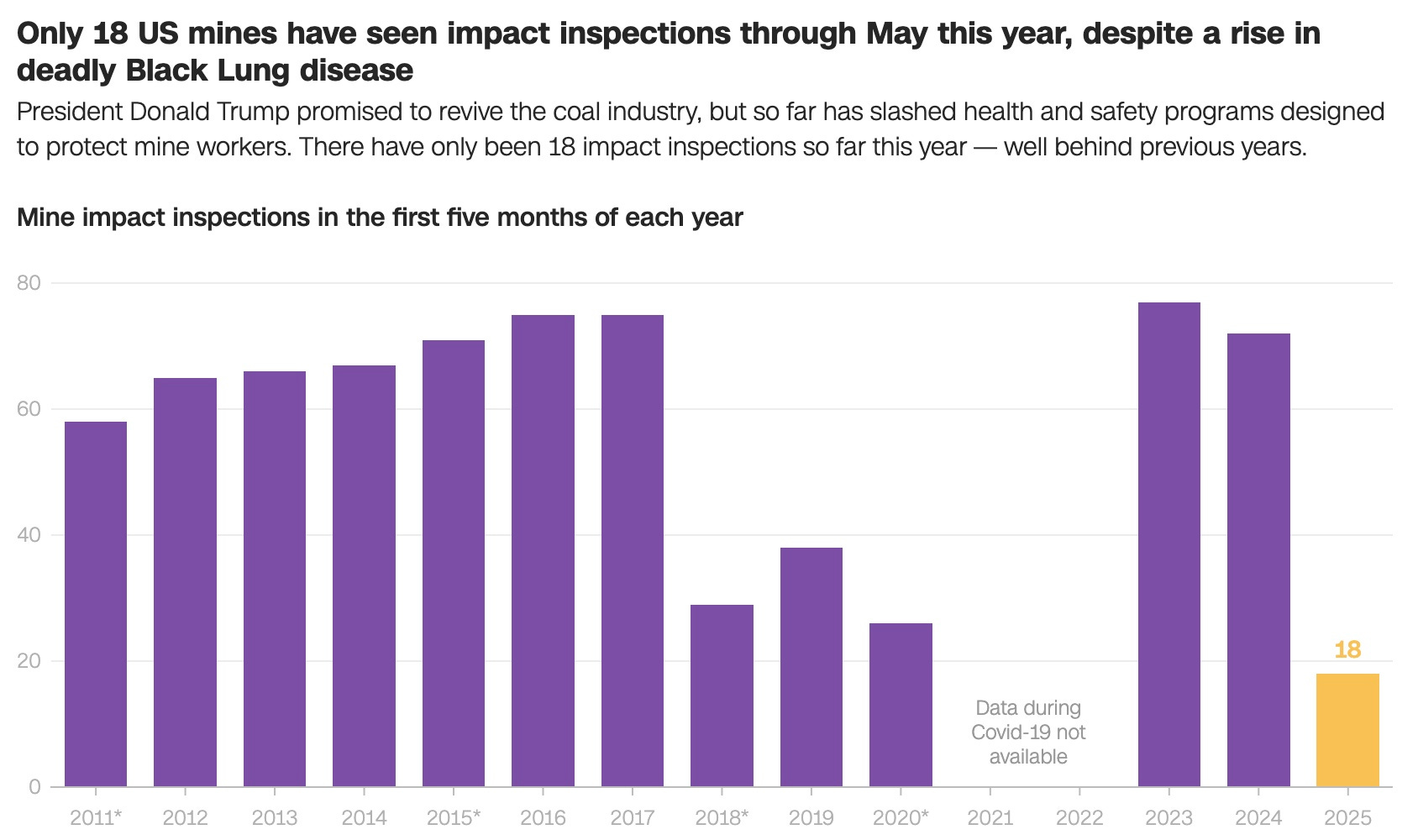
According to a CNN report,
Trump has argued that he can reinvigorate the coal industry by cutting red tape and ‘removing Federal regulatory barriers that undermine coal production.’ […] ‘We’re ending Joe Biden’s war on beautiful, clean coal once and for all, Trump said at an April 8 signing ceremony for his executive orders. ‘And we’re going to put the miners back to work.’
Trump’s stance won votes in West Virginia, along with the support of the mine union. Although the union is now rethinking that support. CNN quoted Cecil Roberts of the United Mine Workers of America as saying:
Look, we’re the biggest cheerleader [Trump] could possibly have in creating new jobs, because Appalachia is in desperate need of jobs. We don’t fault the president on that end. But you can’t bring people back and kill them. I mean, how much sense does that make?
Apparently, it makes financial sense to some people. When a corporation's primary goal is to maximize shareholder value, people like Wilbur Ross might look at their bank accounts and determine that workers’ safety, well-being, and their lives become just another cost of doing business.
https://minesafety.wv.gov/PDFs/sago/Sagoreport/for%20web%201-20-07/Sago%20Report_Full%20doc(less%20appendices)/Sago%20Report-%20Full%20doc_less%20appendices.pdf.
https://www.nytimes.com/1997/10/13/us/national-news-briefs-in-west-virginia-4-die-in-crash-of-a-helicopter.html.
https://minesafety.wv.gov/PDFs/sago/Sagoreport/for%20web%201-20-07/Sago%20Report_Full%20doc(less%20appendices)/Sago%20Report-%20Full%20doc_less%20appendices.pdf
https://arlweb.msha.gov/FATALS/2006/sago/ftl06c1-12.pdf.
https://www.forbes.com/sites/michelatindera/2017/01/18/how-wilbur-ross-made-a-fortune-in-blue-collar-industries/
Great reporting!