
Qualified Immunity
Understanding and fixing the rot in our justice system.

ICE agents are violating the constitutional rights of U.S. citizens, and the President and Vice President are supporting them. This seems apocalyptic. But this is not new. Government agents have been violating civil rights for decades, and a majority do not face consequences. Why? In large part because of an obscure legal doctrine called qualified immunity. Qualified immunity is not a law passed by Congress. It is a legal approach invented by the Supreme Court in the 1960s to shield police officers who arrested civil rights protesters from civil lawsuits. And it has grown in power and scope since then.
Today, qualified immunity means that it will be difficult to pursue, let alone win, a civil lawsuit against any government employee who violates your constitutional rights while doing their job. This is especially true if you are a minority, poor, or otherwise marginalized. A Reuters study found that, between 2017 and 2019, 57% of civil cases brought against police for use of excessive force were not allowed to go to trial because the officers in question were granted qualified immunity.
Before we go too much farther, I want to state that I think police officers are no different from the rest of us. Most are good people; some are not. I have family members who are in law enforcement. I believe that an ethical, well-trained police officer can stand between us and bad actors. I also believe we need to protect ethical, well-trained officers while they do their jobs. But qualified immunity is not the way.
The American Bar Association has a section on its website that discusses qualified immunity. Here’s how that section starts:
The substance of constitutional rights is meaningless if state actors can violate those rights with impunity. Such rights would become, in James Madison’s words, “parchment barriers”—symbolic commitments to individual liberty that do nothing in practice to deter or prevent unlawful misconduct by government agents. Unfortunately, most members of law enforcement operate today in a culture of near-zero accountability. Police officers rarely face meaningful consequences for their misconduct, and the public’s accurate perception of this fact has contributed to what can best be described as a crisis of confidence in our nation’s law enforcement.
We are in this crisis despite a clear and concise law (42 U.S. Code § 1983 - Civil action for deprivation of rights),1 which says that state actors (note here that federal workers are not listed as this pertains to state-level officers)2 are liable to the wronged party if they infringe “any rights, privileges, or immunities secured by the Constitution and laws” against any citizen or “other person” living in the United States. And this crisis persists despite the fact that we have those rights clearly listed in the U.S. Constitution:
Fourth Amendment: No unreasonable searches and seizures
Fifth Amendment: Due process, no self-incrimination
Eighth Amendment: No cruel and unusual punishment
Fourteenth Amendment: Equal protection, due process
How did we get here?
The Supreme Court has, through decades of hand-waving about precedent, made it difficult to bring a suit against government employees, even in obvious cases where a person’s rights were horribly violated. The court used to look at whether an officer acted in good faith. But now, it’s about whether a prior rule has been applied. The Universal Law Group explains:
“In simple terms, the doctrine shields public officials from liability unless their conduct violates a ‘clearly established’ constitutional right. The problem is that courts often interpret ‘clearly established’ to mean that a prior case with nearly identical facts must exist. If no such case exists, an official can be granted immunity, and the victim is left with no legal remedy, even if their rights were clearly violated.”
Why the learned men and women of the Supreme Court believe that our rights, as listed in the Constitution, are not “clearly established” is mystifying to me. But let’s check how this works in practice. This Reuters investigative report is an excellent resource. Here are some additional examples.
Baxter v. Bracey. In 2014, the police confronted a homeless man in Nashville, TN who they said was in the process of committing a burglary. Alexander Baxter surrendered, sat down, and put his hands in the air. Baxter posed no threat, but Officer Bracey unleashed a police dog, which attacked and injured Baxter. Baxter sued for excessive force, but in late 2018, a federal appeals court ruled that his claim should be thrown out under the doctrine of qualified immunity. The reason? A prior case found that when police unleashed a police dog on a suspect who surrendered and was lying down, that action violated his rights. But Baxter was sitting down with his hands up, so the court said that police could not know that Baxter’s rights would be violated if they attacked him with a police dog. So the court granted the police officer immunity.3
Kelsay v. Ernst. In 2014, Melanie Kelsay was at a public pool in Nebraska with her three children and her friend Patrick Caslin. Caslin came up behind Kelsay as if to throw her into the pool; onlookers believed Caslin was assaulting Kelsay, and a pool employee called the police. When police arrived, Kelsay tried to explain that she and Caslin were just “playing around.” When that failed, she stood in front of the patrol car door. More police arrived, including Deputy Matt Ernst. Kelsay began to walk toward her daughter, who was arguing with a patron near the pool doors. Ernst grabbed Kelsay’s arm and told her to ‘get back here.’ Kelsay stopped, turned toward Ernst, and explained that she wanted to know what the patron was saying to her daughter, then continued to walk toward her daughter. Ernst then placed Kelsay—five feet tall and 130 pounds—in a “bear hug” and threw her to the ground, knocking her unconscious and fracturing her collarbone. On appeal, the court said that because there was a prior case where a court granted the officer immunity when he took down a person who had ignored two commands and walked away, there was no “constitutionally significant distinction between one command and two, so no such rule was clearly established when Ernst made his arrest.” The court gave Ernst immunity even though they understood that Ernst assaulted Kelsay, who was “not threatening, violent, or fleeing.”4
Jessop v. City of Fresno. Micah Jessop and Brittan Ashjian operated numerous ATMs and Coin Pusher machines in California. In 2010, California’s Bureau of Gambling Control deemed Coin Pushers games of chance, and in 2013, the Fresno Police Department executed a warrant at three of the plaintiffs’ properties. During the search, officers seized $151,380 in cash and $125,000 in rare coins. Jessop and Ashjian were never charged with committing any crimes. However, when they approached the city regarding the seizure, it claimed only $50,000 had been seized. Jessop and Ashjian brought suit against the City of Fresno and the officers, alleging that the police had effectively used the warrant to steal over $225,000 in cash and rare coins. The officers were granted immunity. Why? Because the court said the officers could not have known that stealing property that had been seized would be a violation of the Fourth Amendment. And, because the court never ruled on whether this behaviour actually does violate the Fourth Amendment, it means that if this situation happens again, the police who steal the property will also qualify for immunity.5
This is absurd, right? Why hasn’t someone demanded change? Well. Lots of people have. Remember the George Floyd protests? They were about exactly this issue: holding police and other public servants accountable for crimes they commit and rights they violate while on duty. There are counter arguments for why we should keep qualified immunity, but there are even stronger rebuttals to those arguments. See the Cato Institute’s guide (scroll down to the bottom) for a summary of these arguments and rebuttals.6
So what happened? Why is our justice system still rotten and getting worse?
2020 and 2021: When all this could have changed.
There are some on the court, Justices Sotomayor and Thomas are the two most prominent, who have argued against qualified immunity. In 2020 and 2021, with Justice Ginsburg and other progressive justices, the court had the potential to form a majority to overturn or weaken qualified immunity. It was just after the George Floyd killing, and the public was largely in favor of eliminating the bureaucratic mess that protects bad government actors, including and especially qualified immunity. There were several cases that the court could have reviewed to amend past wrongs. But in the end, only Justice Thomas went on record in favor of revisiting qualified immunity.
Why? There are some theories. Legislation in Floyd’s name was wending its way through Congress, and there was hope that meaningful police reform was imminent. It’s possible that Sotomayor thought that the Supreme Court wouldn’t need to overturn qualified immunity if Congress were to finally act to abolish it. But Congress didn’t act. The law failed to pass in the Republican controlled Senate. Congress tried again in 2021, but again failed in the Senate. In the meantime, Justice Ginsburg died, and Justice Barrett, who has been more inclined to support policing, joined the court. The moment when the Supreme Court could have corrected qualified immunity faded away.
So here we are. Our society is not equal. It has one set of laws for the public and another for government agents. Because qualified immunity doesn’t just pertain to the police, it shields all government actors while performing their jobs. You know that maxim “ignorance of the law is no defense"? Well, that applies to all of us regular people. But, because of qualified immunity, it doesn’t apply to those who wear a badge. They are protected from liability if they “didn’t know” they were violating your rights. Another maxim, “no one is above the law,” is a nice idea. But in practice, anyone with a badge or a government title generally is.
You know who else is aware of this? J.D. Vance. This is what Vance meant when he said at a press conference following the killing of Renee Good:
“The precedent here is very simple. You have a federal law enforcement official engaging in federal law enforcement action. That’s a federal issue. That guy is protected by absolute immunity. He was doing his job. […] The idea that Tim Walz and a bunch of radicals are going to go after and make this guy's life miserable because he was doing the job that he was asked to do is preposterous. […] I've never seen anything like that. It would get tossed out by a judge."
Vance has a point. If Renee Good’s family tried to sue Jonathan Ross, the ICE shooter, they also might come up against qualified immunity and, like many before them, not be allowed their day in court.
Members of minority groups, members of right wing militias, the poor and the marginalized certainly knew this well before the white liberal establishment reacted in shock at the killing of Renee Good. But, as long as this inequity was primarily experienced by black, poor, and fringe communities, it was easy to ignore.
And now that those same liberal affluent white suburbanites (of which I am one) are waking up to the fact that—oops—they also could be persecuted with impunity, it’s too late. The reins of government—those powerful systems with few checks and balances—are now in the hands of a man willing to listen only to his own morality. That same morality, mind you, that told him that sexually violating a woman is fine, because he was famous and can get away with it. And we (myself included) let this happen because we were too busy living our lives and adding to our 401Ks to pay attention.
How to fix it
Well, I’m glad we are all awake now. So what do we do to fix this?
Support legislation and politicians seeking to ban or curtail qualified immunity. The most recent legislation, the Qualified Immunity Abolition Act, was introduced on January 13, 2026 by Senator Ed Markey (D-MA) in the Senate and Representative Ayanna Pressley (MA-07) in the House of Representatives. The bill is a more comprehensive version of their previous “Ending Qualified Immunity Act” of 2020. The 2026 version specifically grants victims the right to sue federal law enforcement officers, including ICE agents, for civil rights violations and abolishes qualified immunity as a defense.
Work at the state level. Some states and cities have already banned or restricted the use of qualified immunity for state lawsuits, making it easier for victims and victims’ families to have their day in court. These include
Colorado
New Mexico
Montana
Nevada
Connecticut
Massachusetts
California
New York City
Washington, D.C.
Most of us want to abolish or curtail qualified immunity. The Cato Institute found that 63% of Americans (79% of Democrats and 42% of Republicans) want to remove qualified immunity for police and that 8 out of 10 people say police should be accountable for misconduct, even if they were unaware of the law. The Pew Charitable Trust reported that 66% believed that civilians should to be able to sue police officers for using excessive force.
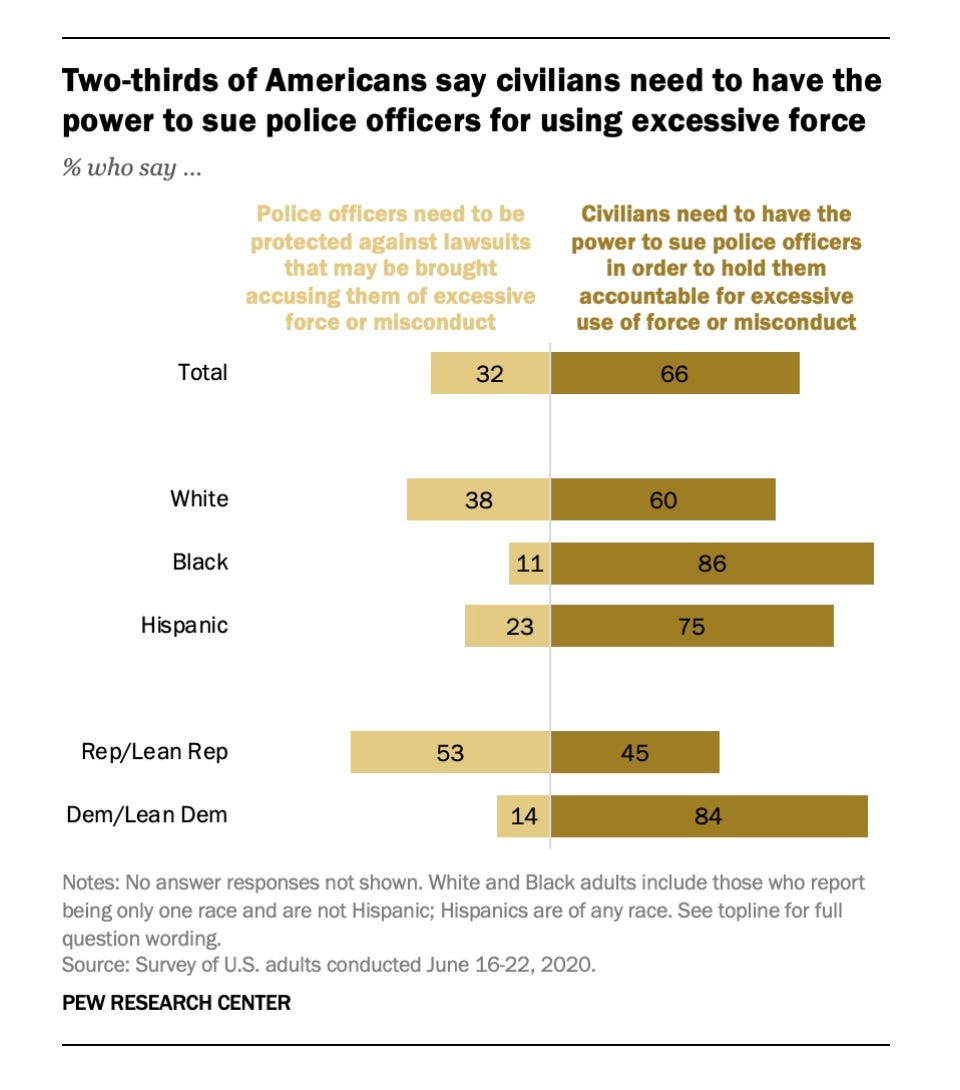
We must not rest until qualified immunity is a thing of the past. Not because we want to hinder police or policing, but because we want to make them better. A world where police and government agents can be held reasonably accountable is a world where our rights are protected, bad actors are not tolerated, and public servants are proud of their service, rightfully deserving the trust we place in them.
“To help vindicate the rights of African American victims of racial terrorism, Congress passed the Civil Rights Act of 1871 (also known as the Ku Klux Klan Act), which was codified as 42 U.S.C. § 1983. This law provides a private right of action for individuals whose constitutional rights have been violated by police officers or other state or local officials.”—Equal Justice Institute
The Supreme Court recognized the right to sue federal agents in the Bivins decision, which has also been significantly eroded over the last 50 years. See: Institute for Justice, IJ.org.
https://www.aclu.org/cases/baxter-v-bracey
https://harvardlawreview.org/print/vol-133/kelsay-v-ernst/
https://www.cato.org/publications/legal-briefs/jessop-v-city-fresno-scotus#:~:text=Jessop%20and%20Ashjian%20brought%20suit,characterizes%20modern%20qualified%20immunity%20doctrine.
Please take a moment to read that website. It’s important information and the only reason I didn’t include it here was because the post was getting too long.